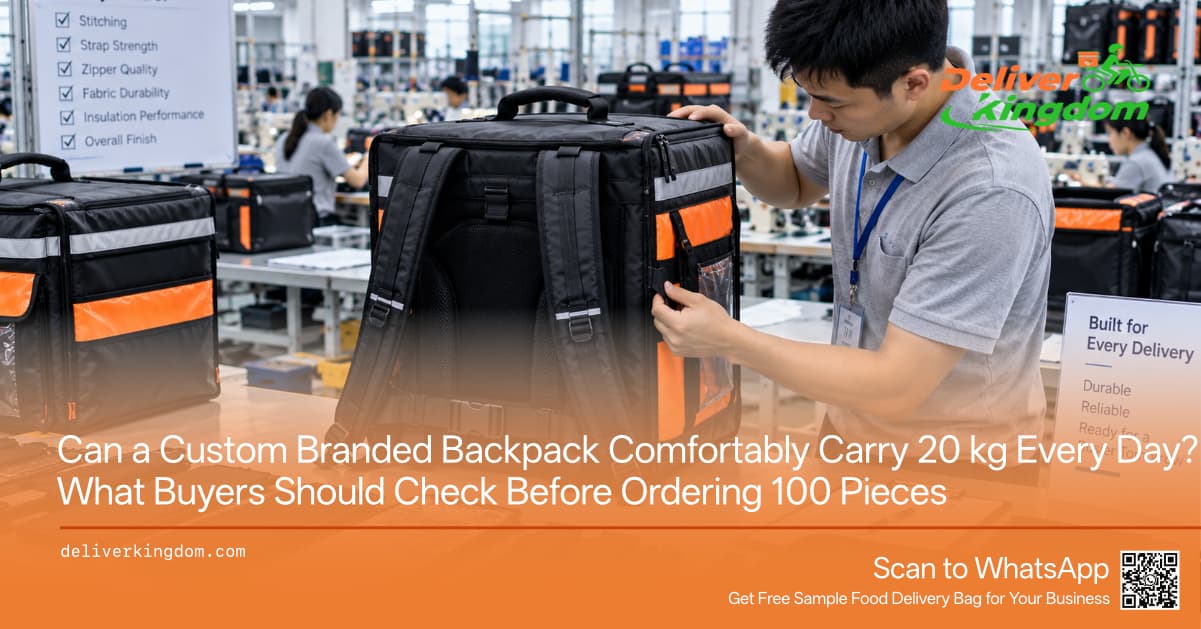
Is a Standard Promotional Backpack Really Suitable for a 20 kg Daily Load?
A recent custom backpack inquiry asked for approximately 100 branded backpacks intended for everyday use, with each backpack expected to carry around 20 kg for extended periods. That requirement immediately changes the product-selection process. A basic promotional backpack may look good with a printed logo, but it is usually designed around laptops, documents, clothing, or lighter personal items. Twenty kilograms creates much higher stress on the shoulder strap attachments, top handle, zipper area, bottom panel, seams, and the user’s back. For this reason, the first question should not be “Which backpack has the lowest unit price?” It should be “Which existing construction was originally designed to handle this type of repeated load?” DeliverKingdom recommends starting with models that already have a reinforced back system, wider padded shoulder straps, stronger bottom construction, multiple load-bearing stitch points, and enough internal structure to prevent the contents from concentrating all the weight in one area. A custom backpack for 20 kg daily load should be treated more like working equipment than a giveaway bag with a logo added to the front.
Why the Existing Model Should Be Selected Before Custom Branding Begins
When a buyer needs only 100 pieces, developing an entirely new backpack pattern from zero may not be the most efficient route. A better approach is often to review several existing models that already come close to the required load, dimensions, compartment layout, and carrying comfort, then customize the selected construction. This reduces development risk and allows the buyer to judge a physical product rather than approving everything from drawings. For an order intended for daily use in an African market, DeliverKingdom would first recommend existing backpack models with reinforced shoulder strap connections, structured back panels, strong zippers, water-resistant outer fabric, and enough compartment organization for the intended contents. Product photos, dimensions, available colors, and construction details can then be compared before a sample is made. The buyer may discover that the visually simplest model actually has the strongest carrying structure, while another model with more pockets is less suitable for concentrated weight. Selecting the right base model first also makes later decisions about embroidery, printing, colors, packing, and shipping much easier.
What Shoulder Strap and Back Panel Design Matters at Higher Loads
At around 20 kg, shoulder straps become one of the most important parts of the backpack. Simply adding thicker foam does not automatically make a bag comfortable. Strap width, curvature, attachment position, padding density, webbing reinforcement, and the distance between the straps all affect how the load sits on the body. A reinforced backpack for long-term carrying should also have a padded back panel that helps distribute pressure instead of allowing hard objects inside the bag to press directly against the wearer. Breathable mesh can improve comfort in warm environments, especially for daily outdoor use, but the underlying foam and panel structure still need enough support. Depending on the exact backpack size and use case, a chest strap or waist support may also be worth discussing if 20 kg is expected to be carried for long periods rather than only moved short distances. DeliverKingdom can review these details during model selection instead of assuming any backpack with padded straps is suitable. At this load, comfort is not a decorative feature. It affects whether the backpack is practical after thirty minutes, two hours, or a full working day.
Reinforced Stitching and Stress Points Buyers Should Inspect
Most backpack failures do not begin in the middle of a large fabric panel. They begin at concentrated stress points. Shoulder straps tear where they join the upper back panel. Top handles pull away from the body. Bottom seams open after repeated loading. Zipper ends separate where the user pulls hardest. For a custom branded backpack designed for approximately 20 kg daily carrying, these areas need reinforcement before production begins. DeliverKingdom can use additional webbing, bartack stitching, reinforced seam construction, stronger backing material, and multi-layer attachment points depending on the selected model. Buyers should also inspect how the bottom panel connects to the sidewalls, because twenty kilograms placed repeatedly into the same bag can create significant downward force. The sample should be tested with realistic contents instead of being evaluated only while empty. This is also why a request for “reinforced stitching” needs to become specific during development. Adding more stitches everywhere is not the goal. Reinforcing the places where the load actually transfers through the backpack is what makes the difference between a useful working bag and a very nicely embroidered future warranty complaint.
Choosing Water-Resistant Fabric, Zippers, and Internal Structure
For daily commercial use, the outer material should balance durability, water resistance, appearance, weight, and cost. Oxford polyester, coated polyester, and similar woven materials can be suitable depending on the required finish and budget. A water-resistant outer fabric helps protect documents, electronics, clothing, tools, or other contents from light rain and splashes, but buyers should distinguish between water-resistant construction and a completely waterproof backpack. Zippers also matter. A strong commercial zipper with reliable sliders may be more useful than specifying an expensive waterproof zipper when the actual application only requires protection from ordinary rain. Internally, the backpack should have enough structure to prevent a 20 kg load from pulling the bag completely out of shape. DeliverKingdom can recommend fabric weight, lining, padding, support panels, zipper specifications, and reinforced bottom construction based on the selected model. For buyers in an African market, climate, outdoor exposure, transportation method, and cleaning requirements should also be considered before finalizing materials rather than choosing a fabric only because it looks rugged in a product photograph.
How Multiple Compartments Affect Weight Distribution
Multiple compartments are useful, but more compartments do not automatically make a better high-load backpack. The main purpose should be to keep heavier items close to the wearer’s back and prevent dense objects from moving freely inside the bag. If a 20 kg load sits too far away from the body, the backpack creates more leverage on the shoulders and can feel significantly less comfortable. A well-designed custom backpack for 20 kg daily load may therefore use one strong main compartment, one secondary compartment, and several smaller organizational pockets instead of dividing the bag into too many shallow sections. Laptop-style sleeves, document pockets, internal zipper areas, side pockets, and front storage can still be added depending on the application. DeliverKingdom can recommend existing models where the compartment layout supports load distribution instead of merely increasing the number of features listed in the catalog. During sampling, the buyer should load the exact type of items expected in daily use and check whether the backpack remains balanced while walking. A specification sheet may say “multi-compartment,” but gravity remains annoyingly uninterested in marketing terminology.
Comparing Screen Printing, Embroidery, and Full-Color Logo Printing
Once the correct backpack structure has been selected, branding can be matched to the artwork and desired appearance. Screen printing is often suitable for relatively simple logos with solid colors and can provide an efficient solution for commercial quantities. Embroidery gives a more textured and durable appearance, particularly for logos placed on structured front panels, but it adds stitching through the fabric and may not suit very detailed artwork or very large areas. Full-color printing is more appropriate when the design includes gradients, photographic elements, or multiple colors that cannot be reproduced efficiently through conventional screen printing. DeliverKingdom can review the final artwork before recommending the most appropriate branding process. Placement also matters. A logo should not be positioned directly across a heavily curved area, zipper path, or stress point simply because the front of the bag technically has space. For a 100-piece custom branded backpack order, the buyer can compare the visual effect, unit cost, and durability of each branding method during sample development before confirming bulk production.
Why a Physical Sample Matters Before a 100-Piece Order
A 100-piece order is large enough that a design mistake becomes expensive, but small enough that the buyer should avoid unnecessary development cost. This makes the physical sample particularly valuable. The sample can verify whether the chosen backpack is genuinely comfortable under a realistic 20 kg load, whether the straps remain stable, whether the bottom keeps its shape, whether the zippers are easy to operate, and whether the compartment layout works with the intended contents. The buyer can also review the selected color, logo position, print or embroidery quality, lining, stitching, and overall appearance before authorizing production. DeliverKingdom can provide sample development based on an existing model so the buyer does not need to commit to 100 pieces based only on photographs. The sample also becomes a practical production reference. Once dimensions, materials, logo placement, colors, and structural details are approved, the same specification can be during bulk manufacturing. Spending time on one correct sample is generally more efficient than explaining why one hundred finished backpacks have the same incorrect shoulder strap.
Why Buyers Choose DeliverKingdom for Custom Branded Backpack Projects
DeliverKingdom has worked in bag and delivery-equipment manufacturing since 2013 and operates a production facility covering more than 12,000 square meters in Yangchun, Guangdong, with over 400 employees. The company holds BSCI and ISO9001 certification and supports commercial projects involving custom backpacks, insulated bags, delivery backpacks, and related equipment. For a reinforced backpack for long-term carrying, the value of working with DeliverKingdom is not simply adding a logo to an existing product. The team can first review the intended load and daily application, recommend suitable existing constructions, develop a sample, and then customize materials, colors, dimensions where feasible, compartments, logo methods, and packaging. Buyers can choose screen printing, embroidery, full-color branding, and other options according to the design. DeliverKingdom also supports repeat orders and larger quantities if the first project performs well. This makes the relationship more useful for companies looking for a dependable supply program rather than purchasing one batch of generic backpacks from whichever catalog happens to have the lowest number beside it.
Planning Production, Packaging, and Shipping for an African Market
Once the sample and specifications are confirmed, the project moves into commercial planning. For a 100-piece backpack order, the buyer should confirm available colors, final dimensions, packing method, carton quantity, gross weight, production lead time, payment terms, and shipping preference before production begins. Air freight may be useful when the backpacks are needed quickly, but backpacks can occupy substantial volumetric space, meaning freight charges are influenced by carton dimensions as well as actual weight. Sea freight generally offers a more economical option for less urgent commercial orders, though the total transit and destination-handling process is longer. Foldable or compressible backpack structures may help reduce carton volume, but excessive compression should not damage padding or deform the finished product. DeliverKingdom can provide packing information after the final model is selected because carton dimensions and shipping estimates depend on the exact backpack rather than an abstract “100 pieces.” For buyers importing into an African market, comparing both air and sea options after sample approval provides a much more realistic landed-cost picture than estimating freight before the product itself has been chosen.
Q: Can a normal promotional backpack safely carry around 20 kg every day?
A: Not necessarily. A backpack intended for approximately 20 kg should have reinforced shoulder strap attachments, strong bottom construction, durable zippers, suitable fabric, supportive back padding, and a structure designed for repeated higher loads. The selected model should be tested with realistic weight before bulk production.
Q: Can DeliverKingdom recommend an existing backpack instead of developing a new model?
A: Yes. For an order of around 100 pieces, selecting a suitable existing model can reduce development time and cost. DeliverKingdom can recommend models based on load, carrying comfort, compartment requirements, dimensions, and branding needs before preparing a customized sample.
Q: Which logo method is best for a custom branded backpack?
A: Screen printing is suitable for many simple logos, embroidery provides a textured and durable appearance, and full-color printing works better for complex multi-color artwork. The best option depends on the artwork, fabric, logo size, placement, desired appearance, and budget.
Q: Why choose DeliverKingdom for reinforced custom backpacks?
A: DeliverKingdom has worked in bag manufacturing since 2013 and operates a factory covering more than 12,000 square meters with over 400 employees. The company supports model selection, OEM and ODM customization, materials, colors, branding, sampling, bulk production, and repeat orders, with BSCI and ISO9001 certification supporting factory and quality-management evaluation.
Q: Can DeliverKingdom provide both air and sea shipping options for an African market?
A: Yes. Once the final backpack model and packing method are confirmed, carton dimensions and gross weight can be calculated so suitable air and sea shipping options can be compared. The final logistics cost depends on shipment volume, weight, destination, and selected transport method.



 Get a Quote Online