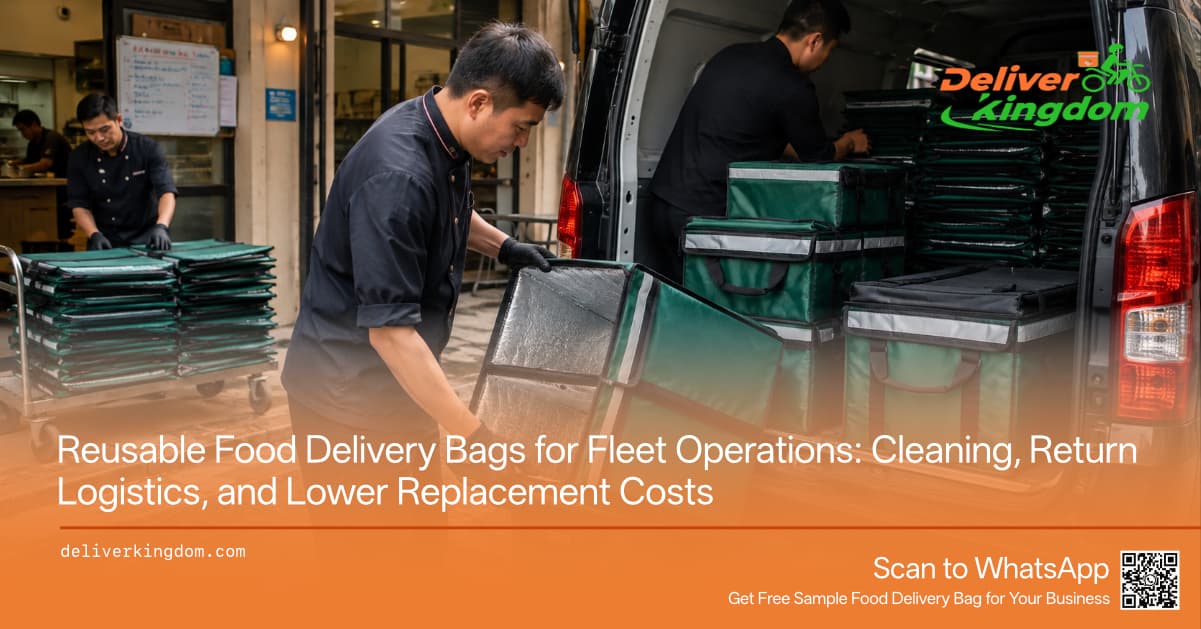
Why the Real Cost of a Food Delivery Bag Starts After the First Delivery
Procurement teams often compare food delivery bag quotations by unit price. That is understandable, but it only shows the cost of getting the bag into the warehouse. The more interesting cost begins after the first delivery. How many times can the bag be reused? How quickly does the lining become dirty? Does the structure collapse after repeated folding? Can riders clean it easily? Does the zipper still work after months of opening and closing? A reusable food delivery bag for fleet operations should be evaluated across hundreds or thousands of delivery cycles, not during the first week when everything is still suspiciously clean. For restaurant chains, food logistics companies, central kitchens, and delivery operators, a bag that costs slightly more but survives longer may reduce replacement purchases, emergency stock shortages, and inconsistent equipment across riders. DeliverKingdom has manufactured food delivery equipment since 2013, giving the company more than a decade of experience with bags that are expected to work repeatedly in commercial environments rather than sit politely in a catalog photo.
How Cleaning Difficulty Shortens the Working Life of Delivery Bags
Food delivery bags get dirty in very predictable ways. Soup leaks near the bottom corners. Oil collects around seams. Milk tea spills under removable partitions. Condensation forms when chilled products stay inside for a long route. Then someone wipes the obvious area and puts the bag back into service. After enough repetitions, odor builds up and the inner surface becomes unpleasant even though the outer shell may still be structurally usable. An easy-clean insulated food delivery bag for restaurant chains can reduce this problem through waterproof lining, smoother internal surfaces, removable support panels, and structures that allow staff to reach corners during cleaning. DeliverKingdom can customize PEVA lining, aluminum foil lining, coated fabrics, removable dividers, zipper openings, and Velcro construction according to the buyer’s cleaning routine. The practical advantage is simple: a bag that is easier to clean is more likely to be cleaned properly. That helps extend useful life, reduce odor complaints, and keep older bags looking acceptable for longer instead of sending them into retirement because somebody spilled curry three months ago.
Why Foldable Food Delivery Bags Matter After the Route Is Finished
The delivery trip only explains half of the logistics problem. After the meals are delivered, the bag still has to come back. An empty rigid box occupies almost the same vehicle space as a full one, which is wonderfully inefficient when a catering van or restaurant fleet is returning dozens of empty units. A foldable food delivery bag for return logistics can reduce this wasted space by using removable panels, flexible sidewalls, Velcro connections, zipper assembly, or other collapsible structures. The bag remains structured when loaded, then folds flatter when it is empty. This is useful for central kitchens, meal distribution companies, restaurant chains, and regional warehouses that regularly move empty bags between locations. It can also make seasonal storage easier when extra bags are kept for promotions or new-store launches. DeliverKingdom can adjust the balance between foldability and support according to the application. Pizza delivery may require stronger horizontal panels, while standard meal-box distribution may allow a lighter collapsible structure. The benefit is not simply that the bag folds. It is that empty equipment stops behaving as if it deserves its own apartment inside the van.
Designing Bags for Repeated Loading, Unloading, and Daily Handling
Commercial delivery bags are handled far more aggressively than most retail bags. A rider lifts the same food delivery bag by its handles dozens of times during one shift. Staff pull the zipper open while the bag is still mounted on a motorcycle. Boxes are pushed against internal walls. The bottom panel repeatedly carries stacked meals. At the end of the day, the bag may be folded, stacked, cleaned, and thrown back into circulation the next morning. This repeated mechanical stress affects stitching, webbing, zipper attachment, support boards, and corners. A reusable food delivery bag for fleet operations should therefore be designed around the number of handling cycles, not only the maximum weight of one delivery. DeliverKingdom can customize reinforced handles, stronger webbing positions, bottom support, structural panels, zipper direction, opening size, and fabric according to the customer’s actual use. The advantage for fleet operators is fewer early failures in predictable stress points. Instead of replacing an entire bag because one handle attachment tears, the structure can be designed from the beginning around where riders actually pull, lift, drag, and load it.
Managing Odor, Grease, Moisture, and Food Spills Over Long-Term Use
A bag can still keep food warm and yet become unsuitable for professional use because it smells terrible. This is one of the less glamorous realities of reusable delivery equipment. Fried food leaves oil. Seafood leaves stronger odors. Hot meals create steam. Cold drinks create condensation. If moisture becomes trapped inside the insulation or seams, drying takes longer and the next order may enter a bag that already smells like the previous three restaurants. An easy-clean insulated food delivery bag for restaurant chains can be designed with water-resistant internal layers, removable components, wide openings, and fewer difficult-to-reach spaces. DeliverKingdom can also help buyers choose different inner materials depending on whether the operation mainly carries hot meals, chilled products, drinks, or mixed orders. Some buyers may prioritize a smooth lining that can be wiped quickly between shifts. Others may need removable internal dividers that can be washed separately. Matching the internal structure to the real food category helps reduce odor buildup and makes hygiene routines more practical, which is rather more useful than writing “easy to clean” on a specification sheet and hoping nobody investigates further.
Standardizing Reusable Food Delivery Bags Across Restaurant Locations
Reusable equipment becomes difficult to manage when every store uses a different bag. One branch has a 45-liter model, another has a 60-liter version, a third uses different replacement panels, and nobody remembers which zipper design was ordered last year. The result is a tiny operational museum where nothing matches anything else. A reusable food delivery bag for fleet operations can be standardized across store networks using fixed dimensions, fabric, color, lining, logo position, divider design, and replacement components. DeliverKingdom supports custom sizes, Pantone color matching, logo printing, reflective elements, internal compartments, handle structures, and foldable designs. Once a restaurant chain approves one specification, future stores can order the same model rather than rebuilding the product from zero. This is particularly useful for franchise groups and multi-city delivery operations where local purchasing can quickly create inconsistent equipment. Standardization also makes training easier because riders and store staff learn one opening method, one folding process, and one cleaning routine. The benefit sounds mundane, but mundane consistency is exactly what keeps large operations from slowly turning into folklore.
Customizing Materials and Structures Around Real Cleaning Routines
There is no single correct material for every food delivery bag. A restaurant that wipes bags manually after every shift has different needs from a central kitchen that operates a dedicated cleaning station. A beverage-delivery company may worry more about liquid leakage, while a pizza business may care about grease, heat, and structural support. DeliverKingdom’s OEM and ODM capability allows the food delivery bag to be built around these routines instead of forcing the buyer into one standard material combination. Outer options can include Oxford fabric, PVC-coated polyester, or TPU-coated fabric, while internal layers may use PEVA, aluminum foil, insulation foam, and removable support boards depending on requirements. An easy-clean insulated food delivery bag for restaurant chains may use a wide opening so staff can reach the bottom corners quickly. A foldable food delivery bag for return logistics may prioritize removable panels so the structure can collapse after use. Buyers can also customize dimensions, colors, logos, closures, dividers, label pockets, and reinforced areas. This turns customization into an operational tool rather than merely choosing which shade of red gets printed on the outside.
Why DeliverKingdom Is Built for Long-Term Fleet Supply
Choosing a food delivery bag manufacturer becomes more important when the product will be reordered repeatedly. A restaurant chain may buy an initial batch for 200 riders, replace part of the fleet months later, then require another quantity when new stores open. If the manufacturer cannot reproduce the approved size, color, material, logo, and structure consistently, each reorder becomes another sourcing project. DeliverKingdom has focused on delivery equipment since 2013 and operates a manufacturing facility of more than 12,000 square meters in Yangchun, Guangdong, with over 400 employees. The company holds BSCI and ISO9001 certification and supports food delivery bags, insulated totes, thermal backpacks, rider helmets, jackets, and protective equipment. For buyers, the reason to choose DeliverKingdom is not simply factory size. It is the combination of OEM and ODM development, material customization, sizing, branding, bulk production, and future repeat-order support. The supplier can stay with the product through sampling, commercial use, replacement, expansion, and specification updates rather than treating the first shipment as the end of the relationship.
Planning Replacement, Reorder, and Expansion Without Changing Specifications
Reusable does not mean permanent. Eventually every food delivery bag reaches the end of its useful life. The goal is to make replacement predictable rather than chaotic. Restaurant chains can monitor common failure points such as zippers, handles, lining damage, insulation deformation, odor retention, and faded branding, then plan replacement quantities before equipment becomes unusable. This works much better when the original bag specification can be reordered. DeliverKingdom helps commercial buyers maintain consistent custom requirements for fabric, dimensions, color, logo placement, insulation structure, internal dividers, and packing. A reusable food delivery bag for fleet operations can therefore become part of a longer equipment program rather than a one-time purchase. New riders can receive the same model used by existing teams. New franchise stores can launch with the same approved design. Seasonal reserve stock can match the normal fleet. Buyers can also revise specific details in future orders if field use reveals an improvement, such as stronger handles or a different divider arrangement, without redesigning the entire product. That kind of gradual improvement is much cheaper than repeatedly learning the same lesson through damaged bags.
Building a More Efficient Reusable Delivery Bag Program
A better food delivery bag program begins by looking beyond the purchase order. Buyers should consider how the bag will be loaded, carried, cleaned, dried, folded, returned, stored, inspected, and eventually replaced. They should record meal-box dimensions, average weight, delivery frequency, vehicle type, cleaning process, storage space, route length, required branding, and expected quantity. DeliverKingdom can use this information to develop an easy-clean insulated food delivery bag for restaurant chains, a foldable food delivery bag for return logistics, or a reusable food delivery bag for fleet operations based on the actual workflow. Samples can be tested during real delivery shifts before bulk production. Staff can check whether the lining is easy to wipe, whether the bag folds quickly, whether the handles are comfortable, and whether the internal structure survives repeated loading. DeliverKingdom supports OEM and ODM development, fabric and material customization, size adjustment, color matching, logo printing, large commercial orders, and future repeat supply. For restaurant chains, central kitchens, food logistics operators, cold chain businesses, and trading companies, the result is not simply a better bag. It is a more manageable equipment lifecycle.
Q: How can a reusable food delivery bag reduce long-term operating costs?
A: A reusable food delivery bag can reduce replacement frequency when its fabric, insulation, handles, lining, and structural support are designed for repeated commercial use. Easy cleaning and foldable storage can also help extend useful life and reduce storage or return-logistics pressure.
Q: Can DeliverKingdom make food delivery bags easier to clean?
A: Yes. DeliverKingdom can customize PEVA or aluminum foil lining, waterproof inner surfaces, removable dividers, support panels, wide openings, zipper systems, and other structures according to the customer’s actual cleaning routine.
Q: Can food delivery bags be folded after use?
A: Yes. A foldable food delivery bag for return logistics can use removable support boards, flexible walls, Velcro connections, zipper assembly, or other collapsible structures. The exact design depends on the insulation and support required during delivery.
Q: Why choose DeliverKingdom for repeat food delivery bag orders?
A: DeliverKingdom has focused on delivery equipment manufacturing since 2013 and operates a factory covering more than 12,000 square meters with over 400 employees. The company supports OEM and ODM development, custom materials, dimensions, colors, logos, bulk production, and repeat orders. BSCI and ISO9001 certification also provide references for factory and quality-management evaluation.
Q: What should buyers provide before developing a reusable food delivery bag?
A: Buyers should provide bag dimensions or food-box sizes, expected quantity, food type, daily usage frequency, carrying method, cleaning process, storage requirements, logo artwork, preferred color, and any special needs such as waterproof lining, removable dividers, reinforced handles, or foldable construction.



 Get a Quote Online